
青藏高原内陆冰坝湖泊的演化与排水
近日,bet36体育投注:青藏高原研究所安宝晟团队研究了青藏高原内陆冰坝湖泊的演化与排水。2026年1月5日,《bet36体育在线:科学:地球科学》杂志发表了这一成果。
冰川湖溃决洪水(GLOFs)在气候变暖和冰川退化背景下日益频繁,对区域生态系统、地貌和人类系统产生了深远影响。冰坝湖占全球GLOFs的近70%,然而,在青藏高原腹地等偏远地区,其动态仍知之甚少。
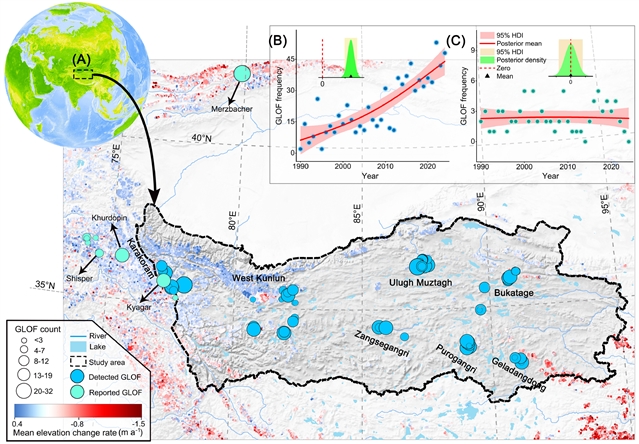
研究组首次利用多源卫星图像对该地区冰坝湖的演变和排水情况进行了系统评估。1973年至2024年间,由于反复排水和水库容量减少,冰坝湖的数量从256个增加到323个,而总面积则从22.66±0.93平方公里减少到20.43±1.6平方公里。新形成的湖泊倾向于向高海拔地区转移。基于湖泊面积的突然减少,共检测到775起之前未报告的GLOFs。
贝叶斯回归分析显示,GLOF频率急剧上升,从1990-1994年期间的平均每年11起增加到2020-2024年期间的每年42.6起。同时,与1990年相比,GLOF发生时间提前了9.07±3.71天,且排水前的湖泊面积减少了0.02±0.01平方公里。这些发现凸显了冰坝湖在气候变化和冰川退缩背景下的演变行为,对区域冰冻圈研究和减灾工作具有重要意义。
附:英文原文
Title: Evolution and drainage of ice-dammed lakes in the interior Tibetan Plateau
Author: Taigang ZHANG, Weicai WANG, Xin WANG, Yilong LIAO, Baosheng AN
Issue&Volume: 2026/01/05
Abstract: Glacial lake outburst floods (GLOFs) are increasingly frequent under warming and degradation, exerting profound impacts on regional ecosystems, geomorphology, and human systems. Ice-dammed lakes account for nearly 70% of GLOFs worldwide, yet their dynamics remain poorly understood in remote regions such as the interior Tibetan Plateau. Here, we present the first systematic assessment of the evolution and drainage of ice-dammed lakes across the region using multi-source satellite imagery. Between 1973 and 2024, the number of ice-dammed lakes increased from 256 to 323, while the total area declined from 22.66±0.93km2 to 20.43±1.6km2 due to repeated drainage and diminished reservoir capacity. Newly formed lakes tended to shift toward higher elevations. A total of 775 previously unreported GLOFs were detected based on abrupt lake area loss. Bayesian regression reveals a sharp rise in GLOF frequency, from an average of 11 GLOFs per year during 1990–1994 to 42.6 GLOFs per year during 2020–2024. Meanwhile, GLOF timing has shifted earlier by 9.07±3.71 days, and pre-drainage lake areas declined by 0.02±0.01km2 compared to 1990. These findings highlight the evolving behavior of ice-dammed lakes in response to climate change and glacial recession, with important implications for regional cryospheric research and disaster mitigation.
DOI: 10.1007/s11430-025-1769-2
Source: https://www.sciengine.com/10.1007/s11430-025-1769-2


